01 · BENEFITS AND RISKS
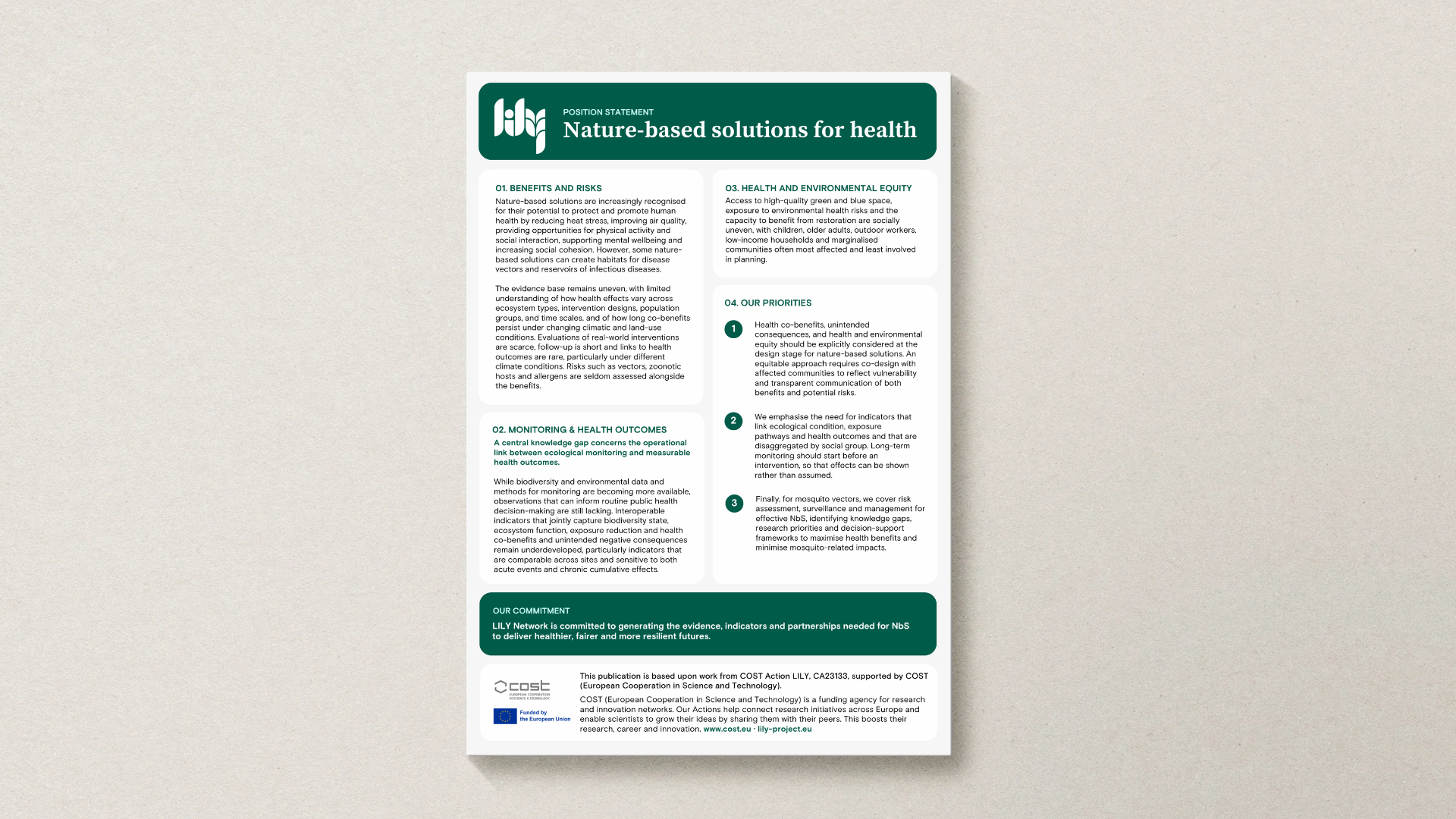
Nature-based solutions are increasingly recognised for their potential to protect and promote human health by reducing heat stress, improving air quality, providing opportunities for physical activity and social interaction, supporting mental wellbeing and increasing social cohesion. However, some nature-based solutions can create habitats for disease vectors and reservoirs of infectious diseases.
The evidence base remains uneven, with limited understanding of how health effects vary across ecosystem types, intervention designs, population groups, and time scales, and of how long co-benefits persist under changing climatic and land-use conditions. Evaluations of real-world interventions are scarce, follow-up is short and links to health outcomes are rare, particularly under different climate conditions. Risks such as vectors, zoonotic hosts and allergens are seldom assessed alongside the benefits.
02 · MONITORING AND HEALTH OUTCOMES
A central knowledge gap concerns the operational link between ecological monitoring and measurable health outcomes.
While biodiversity and environmental data and methods for monitoring are becoming more available, observations that can inform routine public health decision-making are still lacking. Interoperable indicators that jointly capture biodiversity state, ecosystem function, exposure reduction and health co-benefits and unintended negative consequences remain underdeveloped, particularly indicators that are comparable across sites and sensitive to both acute events and chronic cumulative effects.
03 · HEALTH AND ENVIRONMENTAL EQUITY
Access to high-quality green and blue space, exposure to environmental health risks and the capacity to benefit from restoration are socially uneven, with children, older adults, outdoor workers, low-income households and marginalised communities often most affected and least involved in planning.
04 · OUR PRIORITIES
- Health co-benefits, unintended consequences, and health and environmental equity should be explicitly considered at the design stage for nature-based solutions. An equitable approach requires co-design with affected communities to reflect vulnerability and transparent communication of both benefits and potential risks.
- We emphasise the need for indicators that link ecological condition, exposure pathways and health outcomes and that are disaggregated by social group. Long-term monitoring should start before an intervention, so that effects can be shown rather than assumed.
- Finally, for mosquito vectors, we cover risk assessment, surveillance and management for effective NbS, identifying knowledge gaps, research priorities and decision-support frameworks to maximise health benefits and minimise mosquito-related impacts.
OUR COMMITMENT
LILY Network is committed to generating the evidence, indicators and partnerships needed for NbS to deliver healthier, fairer and more resilient futures.
CLICK TO DOWNLOAD ⬇️